Everyone deserves a second chance.
Some people spend their lives trying to escape the mistakes of their past.
Others never get the opportunity.
Yet a rare few continue fighting for redemption even when the world refuses to forget who they once were.
The official story of Kabal is built upon that very idea.
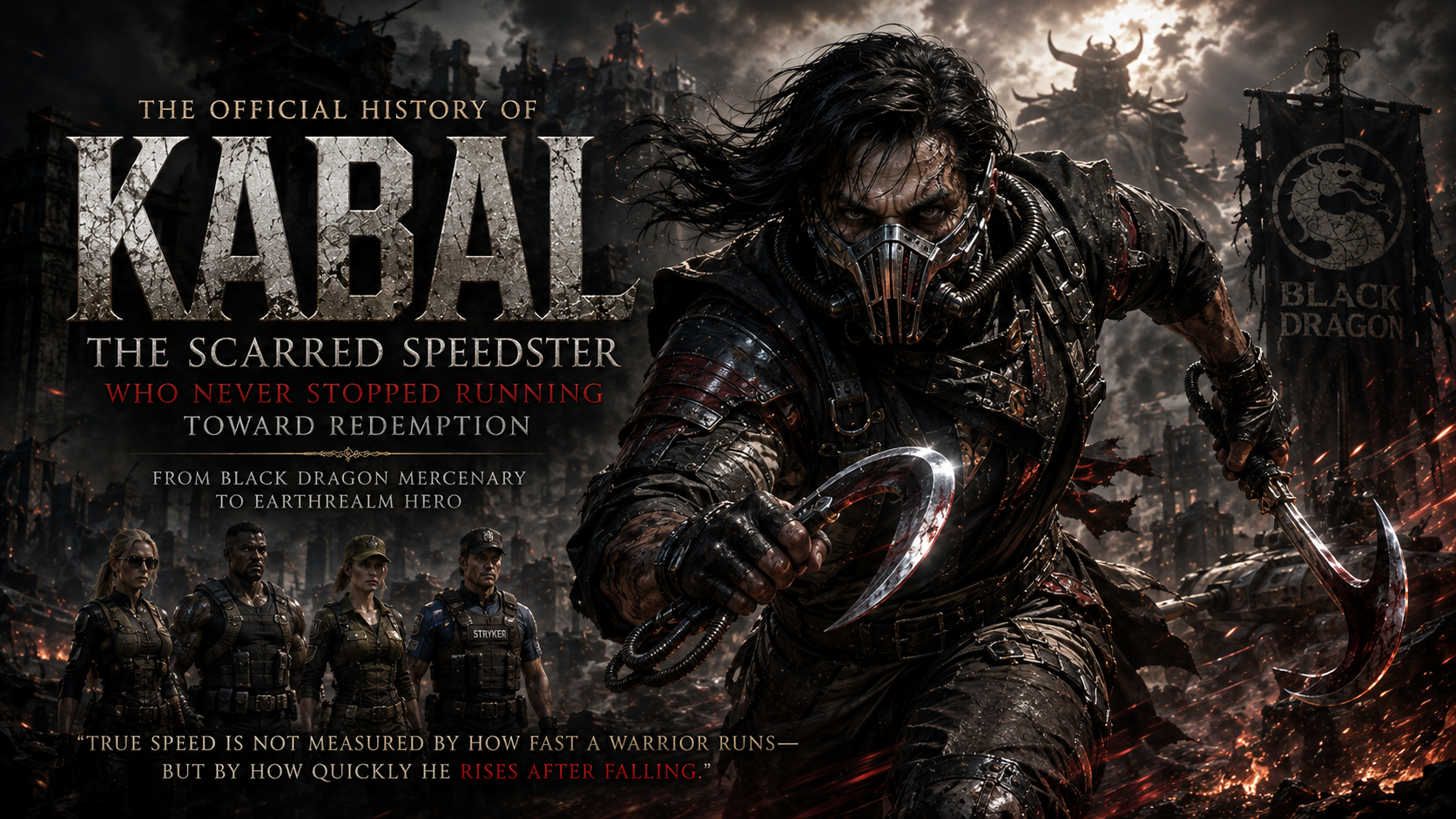
Among the many legendary warriors of Mortal Kombat, Kabal stands apart. He is remembered for moving faster than the eye can follow, wielding twin Hook Swords with deadly precision, and hiding his scarred face behind a respirator mask. Yet beneath that intimidating appearance lies one of the franchise’s most emotional stories—a man forever torn between the life he once lived and the hero he desperately wanted to become.
Unlike gods, emperors, or ancient champions, Kabal’s greatest battle was never against Outworld.
It was against his own past.
A Life Inside the Black Dragon
Before he became one of Earthrealm’s defenders, Kabal lived a very different life.
Official Mortal Kombat lore identifies him as a former member of the Black Dragon, the notorious international criminal organization led by Kano. The Black Dragon thrived through arms trafficking, smuggling, mercenary work, and organized crime. Violence was simply another business opportunity.
Kabal quickly earned a reputation as one of the organization’s most capable operatives.
Fast.
Fearless.
Highly skilled.
His mastery of close-quarters combat and his remarkable agility made him invaluable during dangerous missions.
But unlike many of his fellow criminals, Kabal gradually realized that loyalty inside the Black Dragon was built on greed rather than honor.
Every alliance could be broken.
Every friend could become expendable.
The deeper he looked into the organization’s methods, the more he questioned the path he had chosen.
Choosing Redemption
Eventually, Kabal abandoned the Black Dragon.
Leaving Kano’s organization was not simply changing employers.
It meant turning his back on the criminal life that had defined him.
Seeking redemption, Kabal began working alongside Earthrealm’s Special Forces, where he fought beside warriors such as Sonya Blade, Jax Briggs, and later Kurtis Stryker.
Officially, this decision marked one of the most important turning points in his life.
For the first time, Kabal used his extraordinary combat skills to protect innocent people rather than threaten them.
Although many remained suspicious of his criminal past, Kabal continued proving that people are capable of changing.
The Invasion That Changed Everything
Peace never lasted.
When Shao Kahn launched his invasion of Earthrealm during the events surrounding Mortal Kombat 3, countless cities were thrown into chaos.
Official lore states that Kabal became one of the victims of the invasion.
He suffered catastrophic burns that nearly claimed his life.
Different timelines portray the exact circumstances differently, but the outcome remains consistent.
His body was left horribly scarred.
His lungs were severely damaged.
Without advanced life-support equipment, he would not have survived.
To stay alive, Kabal was fitted with a respirator system and specialized breathing apparatus that became his signature appearance throughout the series.
The man who had finally escaped his criminal past now faced an entirely different struggle.
He had to learn how to live inside a body forever changed by tragedy.
The Birth of the Fastest Warrior
Rather than ending his career, Kabal’s survival became the beginning of something extraordinary.
Official Mortal Kombat games portray him as possessing incredible superhuman speed, allowing him to move so quickly that many opponents cannot even react before his attacks land.
His exact source of speed has never been explained in exhaustive detail within canon, leaving part of his abilities intentionally mysterious.
What matters is the result.
Kabal became one of the fastest combatants ever seen in Mortal Kombat.
Armed with his twin Hook Swords, he developed a fighting style unlike any other.
His movements blended speed, precision, and relentless pressure.
Enemies rarely had time to defend themselves.
Every strike seemed to arrive before they even realized he had moved.
More Than His Mask
To many people, Kabal’s respirator became his defining image.
But the mask represented far more than survival.
It symbolized sacrifice.
Every breath reminded him of the battle that nearly ended his life.
Every mission reminded him that redemption often demands painful consequences.
Unlike warriors who sought recognition, Kabal never wore his scars with pride.
He simply refused to allow them to define him.
The Shadow of Quan Chi
One of the darkest chapters of Kabal’s official story arrived during the events of Mortal Kombat (2011).
After Earth’s champions suffered devastating losses, the necromancer Quan Chi claimed many of their souls.
Kabal became one of those resurrected as a Revenant.
Officially, Revenants retain much of their memories and combat abilities while losing their freedom.
Bound to the Netherrealm, Kabal was forced to fight against the very heroes he had once defended.
For a man who had struggled so hard to leave crime behind, becoming an unwilling servant of darkness was a heartbreaking fate.
It was another reminder that even after redemption, the past can return in unexpected ways.
Different Timelines, Same Inner Conflict
The Mortal Kombat universe has experienced several timeline changes.
Because of this, Kabal’s history has been presented differently across multiple games.
In earlier continuity, he is remembered as a former Black Dragon member who ultimately joined the Special Forces before Shao Kahn’s invasion.
In the rebooted timeline introduced in Mortal Kombat (2011), viewers also encounter a younger version of Kabal before many of those life-changing events occur.
Despite these differences, one central theme never changes.
Kabal constantly stands between two worlds.
One represents crime, greed, and survival.
The other represents justice, responsibility, and redemption.
No matter the timeline, he must decide which path defines him.
The Meaning Behind the Hook Swords
Among Mortal Kombat’s many iconic weapons, Kabal’s twin Hook Swords remain instantly recognizable.
Their curved blades allow him to trap, redirect, and overwhelm opponents with astonishing speed.
Combined with his mobility, they create one of the most aggressive fighting styles in the franchise.
Yet symbolically, the Hook Swords also reflect Kabal’s journey.
One blade represents the life he once lived.
The other represents the future he continues chasing.
He carries both with him.
He cannot erase his past.
But neither is he forced to repeat it.
A Hero Who Never Stopped Trying
Unlike Liu Kang, Kabal was never chosen to become Earthrealm’s champion.
Unlike Raiden, he possessed no divine authority.
Unlike Johnny Cage, he carried no ancient heroic bloodline.
Everything he achieved came through determination.
He made mistakes.
He joined the wrong people.
He paid a terrible price.
Yet he continued trying to become someone better.
That quiet persistence makes Kabal one of Mortal Kombat’s most relatable heroes.
His greatest enemy was never Kano.
Nor Shao Kahn.
Nor Quan Chi.
It was the belief that his past would forever decide his future.
“True speed is not measured by how fast a warrior runs—but by how quickly he rises after falling.”
Throughout Mortal Kombat’s long history, countless warriors have sought power through magic, conquest, or immortality.
Kabal sought something much simpler.
A chance to become a better man.
His burned body became a symbol of survival.
His respirator became a reminder of sacrifice.
His incredible speed became proof that even the deepest wounds cannot stop someone determined to keep moving forward.
Perhaps that is why Kabal remains one of the franchise’s most respected characters.
Not because he is the fastest warrior in Mortal Kombat.
But because no matter how many times darkness tried to pull him back…
He never stopped running toward redemption.